

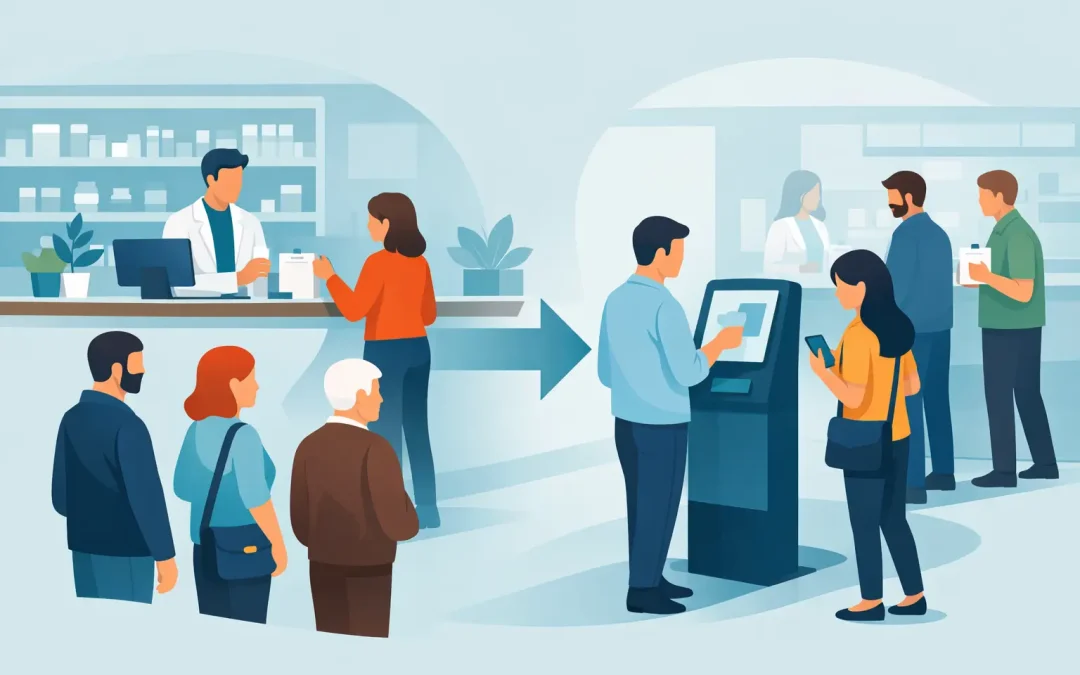
The queue rarely starts because one colleague is working slowly. It starts when a straightforward collection turns into a search for a bag, a price query, a stock check and a payment issue – while the next patient waits. Knowing how to reduce pharmacy queues means removing those small delays from the whole patient journey, not simply asking the counter team to work faster.
For independent and group pharmacies, this matters beyond customer satisfaction. A crowded counter puts pressure on colleagues, interrupts dispensing work and can discourage patients from asking for advice or considering retail purchases. The aim is a calmer operation where patients move through quickly when they need to, while the team still has time for safe, personal service.
Start by finding where the queue actually forms
A queue at the till may be a counter problem, but it is often caused elsewhere. Watch a few busy periods over several days and record the reason for each delay. Morning prescription collections, lunchtime walk-ins and the period after local surgeries close may all behave differently.
Look for repeat patterns. Are colleagues leaving the counter to locate completed prescriptions? Is the team checking a PMR on a separate screen? Are patients waiting while an item is ordered, repriced or substituted? Does a payment terminal lose connection at the busiest point of the day? These are operational issues that can be fixed once they are visible.
It helps to separate queues into three types: prescription collection, retail purchase and clinical or service enquiries. A patient collecting a prepared prescription should not be held up behind someone who needs a Pharmacy First conversation or advice on a new medicine. Equally, a retail customer buying a single item should not need to wait through a complex prescription handover.
Make prescription collection predictable
The fastest collection is the one the team can identify immediately. Clear bagging, consistent storage locations and a simple process for marking prescriptions as ready reduce time spent searching. If bags are filed in slightly different places depending on who prepared them, every collection becomes dependent on local knowledge.
Give every team member the same retrieval routine. Confirm the patient’s details, check the prescription status, collect the bag from a clearly defined location, complete any required checks and process the handover. The exact procedure will vary with your PMR and local SOPs, but consistency is what keeps the queue moving safely.
Counter access to relevant PMR information can make a significant difference. When colleagues can view the information needed for a handover without leaving the patient or asking another member of staff to check a back-office terminal, they can resolve routine questions at the first point of contact. This should support, not replace, appropriate confidentiality controls and clinical escalation.
Text or app notifications can also smooth demand when used carefully. A clear message that a prescription is ready helps prevent unnecessary journeys and repeat enquiries. Avoid sending notifications before the item is genuinely available for collection, however. One premature message can create more counter pressure than it saves.
Design the counter for quick, confident service
The counter should give staff the information and equipment they need within reach. A poorly positioned scanner, printer or card terminal adds seconds to every transaction. At busy times, those seconds become a visible queue.
Check whether colleagues can scan products, view prices, take payment and access the required patient-service information from one working position. Pharmacy-specific EPOS can bring retail sales, pricing data, stock information and dispensing-adjacent prompts into the counter workflow. That reduces switching between systems and gives staff clearer answers while the patient is present.
Rear customer displays are useful here too. They allow patients to see transaction details and payment prompts without staff having to repeat prices or turn the screen towards them. Digital displays can also communicate collection guidance, seasonal services or queue expectations, provided the messages are short and kept current.
Self-service kiosks may help in a pharmacy with enough front-of-shop space and a suitable retail mix. They are most effective for simple purchases, not as a substitute for advice-led service. A kiosk that creates uncertainty, age-verification delays or frequent calls for assistance can merely move the queue to another part of the shop. Test the use case before committing to a wider rollout.
Reduce stock-related interruptions
Nothing slows a counter queue like discovering an item is unavailable after the patient has already asked for it. Accurate stock visibility lets colleagues confirm availability quickly, offer an alternative where appropriate or place an order without a trip to the shelves or storeroom.
Strong stock control is not only about the quantity on hand. It is about reliable data, sensible reorder levels and a straightforward supplier-ordering process. Review your fast-moving lines, seasonal demand and frequent special orders. If a popular product repeatedly reaches zero, the team will keep having the same time-consuming conversation with disappointed customers.
Price accuracy matters just as much. When the shelf edge, the till and the expected price do not match, staff are pulled into explanations and overrides. Using current pricing data and reviewing exceptions regularly protects margin while reducing awkward counter delays.
Match staffing to demand, not habit
Many pharmacies schedule cover around historical rotas rather than actual footfall. A short period of extra counter support can prevent a queue building into a much larger problem. Once several patients are waiting, staff may rush, patients become frustrated and every interaction takes longer.
Use transaction reports alongside local knowledge. Look at sales by half-hour, prescription collection peaks, service activity and delivery timings. Then plan breaks, replenishment and back-office tasks around those moments where possible. Web-based reporting can give owners and branch managers a clearer picture across one site or several, rather than relying on anecdotal impressions.
Cross-training is essential, but it needs boundaries. More colleagues should be able to support the counter, complete basic retail tasks and direct patients appropriately. Clinical questions, safeguarding concerns and Pharmacy First consultations must still move to the right person and space promptly. The objective is not for everyone to do everything. It is for routine work not to stop when one person is unavailable.
Give patients clear routes for different needs
Patients are more patient when they understand what will happen next. A visible collection point, clear signage for consultations and a polite greeting from the first available colleague can prevent uncertainty turning into a queue of people waiting at the same place.
For a busy branch, a simple triage question is often enough: “Are you collecting a prescription, buying an item, or would you like to speak with the pharmacist?” This lets the team direct the person to the right route early. It also protects the pharmacist from being interrupted for requests that a trained counter colleague can resolve.
Do not hide long waits. If a prescription is not ready or the pharmacist is in a consultation, give a realistic expectation and an option where available. Patients respond better to a clear explanation than to being left at the counter without an update.
Use technology to remove hand-offs
The most valuable pharmacy technology does not add another screen or another procedure. It removes a hand-off. A connected counter system can help staff process sales, check stock, access relevant PMR details, record service activity and take payment in one environment. The result is fewer repeated questions and fewer journeys to find information.
This is where specialist implementation matters. Hardware, network reliability, card processing, scanners, displays and staff training all affect queue times. A system can have the right features and still create frustration if the terminals are poorly positioned or the team has not been shown the quickest way to use them. MedEpos approaches this as a full pharmacy counter setup, with software, equipment and ongoing support considered together.
Keep improving after the queue has shortened
Queue reduction is not a one-off project. New services, changing prescription volumes, staff changes and seasonal demand will all alter the pressure points. Review a small number of measures each month: average transaction time, stock-related queries, payment failures, patient feedback and the times when queues form.
Ask counter colleagues what causes avoidable hold-ups. They see the friction that reports cannot always show, from an awkward bag-storage layout to a scanner that intermittently fails. Small fixes often deliver the quickest gains.
A faster pharmacy counter should never feel rushed. When the routine parts of service are organised well, your team has more time for the moments that matter: a proper conversation, a safe handover and a patient who leaves feeling looked after rather than processed.